Flora of the Ancient Cities of Anatolia
- seacraftme
- Jan 3
- 13 min read
Updated: Jan 13
Part I: Alexanders (Smyrnium olusatrum)

To begin, I will admit that I spend most of my days wondering what my purpose is meant to be on this planet. Almost mid-thirty, I feel like a seriously late bloomer, if I should ever bloom at all. Whether I should devote my focus solely on art or agriculture, as my two great interests. Should I go back to school to become a veterinarian or study ethnobotany or botany? Do I finally delve into witchcraft and herbalism? Should I be allotting my time to solving world hunger, like my 10 year old altruistic self would have wanted? Maybe I will be able to do all these in due time.
In an effort to glean any sort of answer, I often ask myself, where do I feel most content, enlivened, and excited to learn? Marie Kondo would ask, "What sparks joy?". Aside from anytime near a cat (meow), there are two places that come to mind where I feel the most inspired. One being pretty much anywhere in nature, even mildly secluded. In the rain or sun, in a rolling grassy pasture or a steep rocky outcrop, a specific locale doesn't matter. As long as the sound of the Earth without humans is louder than the voices in my head, and the flora and fauna are plentiful. The other place being in an art museum (of any age or style), or a museum stuffed to the brim with a collection of artifacts from a local historical site, like those found in abundance here in Turkiye. Which, oddly enough, feels almost exactly opposite to a natural setting. Utterly sterile by design and usually silent, save for the shuffling of feet and quiet discussion among visitors. Maybe a stifled cough from the security guard. Much to the chagrin of my husband, I could spend hours in front of some paintings and installations. They're the closest we have to portals, entered through the mind of another human being, with the ability to take you almost anywhere your mind can fathom. A look into someone else's life, almost akin to reading a book. In the same vein, I could spend just as long examining the trichomes on a Mullein leaf as I could dissecting the brushstrokes of a century old oil painting. Recently, in the last several years (after having visited and lived in Turkiye) I've come to the recognition that where these two places of inspiration coalesce is in the crumbled and half buried ancient cities scattered here. An open-air museum, as it were. Where the creeping vines gently encroach over the carefully carved marble columns, and friezes. To walk over and through the places that were the homes, city streets, shops, and baths of antiquity. To, for a moment, strive to understand how we lived and thrived a millennia ago. To wonder at how delicately our forebears crafted and how devoted to crafting they were. Living in an age and time where we can buy jewelry and household items so cheaply and even absentmindedly, where coming across genuine artists can feel like a rarity, these places awaken a patience in my mind that seems to be slowly disappearing in society today. They invoke the desire to create meaningful lasting objects, and to not only "decorate" our home and landscape, but to transform our dwellings with carefully chosen items of intense beauty and singularity.
Should I then study archaeology or anthropology? Is there an -Ology that studies the ancient plants and their depictions in architecture? An ancient ethnobotany in relation to it's archaeological context? And then, not only in how it's been depicted, but why? Purely elegance or aesthetic purposes? Were the plants that were portrayed heralded, sought-after herbs used for medicinal, culinary, artistic, or functional purposes? What about the plants not chosen for depiction, but those found in abundance near these sites, and less so in currently inhabited places. (Or maybe they were they, but have been paved over or swapped for modern ornamental varieties.) What plants would have been considered valuable enough to include in our archaic diet, but not quite exquisite enough to include in decoration? Much like how a staple crop like cucumber or tomato would be to us today. I've seen plenty of rose or tulip wall-papers, and even a few corn motifs here and there, but nary a Cucurbit to be found gracing our walls.
I remember the exact instance these thoughts began their true germination in my mind, for which I saunter off-course slightly. More than a decade ago, after purchasing a copy of Identifying and Harvesting Edible and Medicinal Plants at the annual Common Ground Fair in Maine, my interest in the plants was thus seeded. I carried this dusty and dog-eared paperback with me on many a hike, and when I moved briefly to southern-coastal California. I found a great joy in happening across plants common to Maine in a "humid continental climate", and marveled at the new species in the unfamiliar "Mediterranean" climate. Coming from the cooler, northern environment found in "central" Maine where everything is lush green in the summer and murky grey in the winter, the hot golden summers of Orange County, with it's pleasantly cool, rainy green winters stood in stark contrast. I learned while volunteering at the Bolsa Chica Conservancy, that there are actually five places on Earth were the Mediterranean climate is found. The other three being in Central Chile, The Western Cape of South Africa and a thin strip along the coast of South-Western Australia. All this to say, when I first visited Turkiye, at the heart of the Mediterranean Basin, the climate and comprising vegetation were not entirely foreign to me. I suspect if by some happening, I had moved directly from Maine to Turkiye, I would have been all but dumbstruck by the contrasting climate.
Luckily however, across the world there are many plants that seem to thrive in a range of conditions, if not quite ubiquitous. My personal favorite of these being the grand and towering Great Mullein. Maybe the first "wild" plants I had become familiar with, both for it's ease in identification with it's massive fuzzy leaves and bright yellow flower stalk (can 2+ meters tall!), and for it's broad-spectrum medicinal properties. I l sought these lovelies out especially cold season during the pandemic. When I moved to Turkiye full time, the COVID was in full swing. Once the lock-downs were over, and we could finally explore again, we got to spend more time in some of the local ancient cities. I began to correlate some of the common plant-based motifs being employed in the decorative carvings. One such time, we had pulled over to examine a site, just off the side of the road (as they often happen). There sat a happy a Wavy-leaf Mullein growing right next a broken column head embellished with what appeared to be the same leaf motif. It couldn't have been spelled out any plainer.
Surely the plants used in antiquity and their significance has been and is presently being studied. I suppose first checking out some of the oldest writings of that time and place would be the best place to start. Pliny perhaps? (I found Pliny The Elder's Natural History compilation from Project Gutenberg. Look up also Theophrastus, Dioscorides, Gaspard Bauhin and Gerard) Papers like this might be exactly what I need to start with (Note, after beginning to read this particular paper, this is exactly the sort content and style I was looking for, even written this past year in September. However this paper only includes the scope of the Mediterranean area through Greece, not encompassing Turkiye.) Has anyone compiled catalogs or done surveys of the vegetation encompassing ancient cities in this area? Who do I have to go to, to learn if that endeavor would be useful? I don't want to unnecessarily reinvent a shitty wheel for the sake of my own ego. But I suppose undertakings done in the pursuit of personal knowledge and adventure would not be altogether in vain.
For now I will begin by noting a few of the native plants that seem to be plentiful around these ancient habitation sites, those specifically along the Aegean coast in our proximity. (I've had it in my mind to do a survey of these plants for a long time, so for now, this first entry will be incredibly stark, and essentially from memory.) These cities being Thera (In some places, also known by the name Okkatas (Read later) and find out where Yedi Delik Magarasi is located), Lagina, Stratonikeia, Idyama, (although now it's closed off and currently undergoing an archaeological dig), Knidos and Kadyanda.
Hold the fucking phone please. While making sure of the spellings of some of these places, I came across an image of a massive cave that I've visited in my dreams. I suppose after staring at this photo for a while, I could have imagined any large underground cave system as such in my dreams with greenery hanging down from a large circular opening above. I guess I do also remember seeing some large carved platforms and columns that were still laying or standing around, that seem to be lacking in this location. In my dream, this place was filled with people picnicking , but dressed in modern clothes of today. The scene reminded me of something reminiscent of Seurat's Sunday Afternoon Painting...and I flew a helicopter out...not so nimbly maneuvered.. But I swear, the cave itself, looked just like this. Maybe we can visit soon. Only a seven hour drive or an hour and a half flight from Istanbul...

I digress, and will begin now with the newest plant I've encountered. This beauty was growing at the city of Lagina, home to the Temple of Hecate, in Yatagan. This is the only known existing temple dedicated to her, of which we are currently aware. She is a true force of the universe not to be fucked with, Goddess of Night, and Keeper of the Worlds in between the living and dead. A guiding light illuminating the path for those who dare venture here. It is here that I cam across Alexanders Smyrnium Olusatrum.
Let me take you there. You can find the grounds at the entrance to the quiet little village of Turgut, down a very unassuming dirt road. There's an old brown sign designating a historical location, pointing you just off the main road. As you enter, the branches form a low tunnel overhead. To your left is a grove of gnarled olives, pomegranates adorned with miniature pale white fruit (yes, not all pomegranates are red) and towering figs, the three most common of the fruit trees here. Hidden uphill, almost out of sight, lays a cemetery, holding a handful of souls from the 1800's, and perhaps before. The head stones towards the back are weather worn, now smooth and blank, their names lost to time, and draped in moss. The Fig leaves, massive and reaching have turned a bright buttery yellow from the November chill, and they filter in a most cheerful magical light. As you continue down the road there is a tall embankment of stacked stones on your right. If you're nimble enough to climb up, you'll peer into one of the first of many stone pools. This one is as deep and wide as a regular above ground swimming pool, so common in American suburbia. If you follow the quite literally beaten paths deeper into the woods, left behind perhaps from grazing goats or local teens (based on the trash and discarded clothing items I'd say the latter), you may spot a wooden cabin. There are several smaller, more intimate stone pool structures here. They appear to have functioned in holding, retaining, and directing water sources. The pool closest to the cabin, a meter wide and deep is faced with a large carved stone slab. The pattern is similar to the round swirling symbol that seems to be associated with Hecate, although not exactly the same. (On that note actually, I have yet to find the symbol analogous with Her on the grounds of Lagina, so I wonder where that actually originated. Perhaps I need to do more digging (metaphorically) around the collected artifacts. Or if that symbol did exist there perhaps the evidence has been taken and stashed away in a museum somewhere.) The vegetation around the cabin shows subtle signs of more formations underfoot, just waiting to be unearthed. The only other visible artifacts are a few broken column pieces covered thickly in Ivy and cloaked in the bramble.


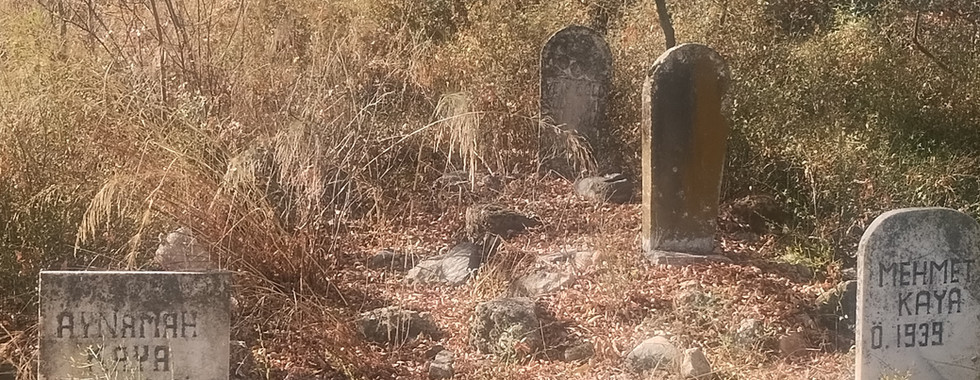




For Future me and those who may come across, buy a better phone. I always buy cheap phones, and the quality of these photos is making me sick. An Instant Kodak Camera gets better quality than this....damn. Also, stop trying to get artsy photos and use the portrait setting on rocks all the time. These are so damn unhelpful as reference photos.
Here, along the backside of the cabin, is a lush patch of green, dominated by the newly sprouting Alexanders, their growth encouraged by the oncoming winter rains. The leaves, are large and shiny, and their shape reminiscent of Celery or a larger form of Parsley. I was careful not to touch them until I had at least roughly identified them, as I'm paranoid of accidentally encountering Poison Hemlock. (Question for future me to investigate: How did ancient peoples cultivate their foods? Did they use some form of a garden bed? Did they grow their foods among the trees in a more organic method as seen in Native populations?) According to several extensive sources I've come across, Alexanders was commonly cultivated in the Mediterranean region, and popular during the reign of Alexander, giving it the moniker: the Parsley of Alexandria. Although I do see now, there are at least six known species, (also look into Turkish researchers Kaya and Basaran) so without further observation from the specimen I came across I suppose I cannot be entirely sure of which I encountered. In Turkish, this plant is known as Yabankereviz, or Wild Celery. Used extensively from root to seed, for both culinary and medicinal purposes, Alexanders seems to have been the vegetable of it's time. Even used in curing and preventing scurvy and for treating a stomach ache, sailors would apparently make special stops just to stock up on this panacea. Popularity spread within the Roman Empire, bringing this herb all the way to the British Isles. Once discovered however, celery, a more mild sister herb, eventually became the preferred crop of choice, leaving Alexanders to the shadows of the less frequented and abandoned areas.
What I find exciting though, is that in the wild, Alexanders grows in coastal areas and salty marshes. I first find this plant arguably inland, Lagina being about 50 km/30 miles from the coast. Now, my first thought, was that I could infer that the specimen I found must have been cultivated, whether from ancient times or perhaps more recently. My second thought to counter this, was wondering if the sea levels have changed enough that Lagina was once considered more coastal to the point that this could be a naturally occurring instance. The city of Efes or Ephesus come to mind. The city currently sits about 5 miles inland. At the western edge of the city there is a naval port that would have once been filled with seawater. Having not researched this before, I had always assumed that the Aegean Sea would have once been flush with this city, and thus the sea level in this area gone out about 5 miles. However, near the coast in a nearly perfect straight line from the city, there is a corresponding man-made channel built at the same time of the city, about a mile from the sea. So at most, the sea level would have only changed about a mile. (Fun aside, I came across this historical map showing the change of the placement of seas as the continents shift. If this is correct, where we live now used to be a series of islands off the eastern coast of Africa and has since been squished into the area that is Central Turkey. Fascinating. I knew I loved Geology.) So for now, let us assume that the specimen at Lagina, was an intentionally planted vegetable.
Back to Alexanders, to break down the scientific name, Smyrnium Olusatrum. There seems to be a general agreement in the root of the genus name relating to Myrrh for it's similar pungent smell and taste and in the species name, meaning "black herb" for the color of it's seeds. However, oddly enough, most of the sources don't seem to make any association with the word/city name of Smyrna, (founded 11 C AD, Pliny wrote of this plant in the 1st C AD) an Aegean port-city now known as Izmir in Turkiye. The roots of the name Smyrna are all relating to bitter or the quality of bitterness, for which this herb is known, and seem to be better fitting in it's exactness of spelling. But perhaps, the word/name came first from the plant's name?
There seem to be plenty of sellers with these seeds available, for use both as an ornamental and a culinary herb. The flowers can be used in arrangements, root prepared like turnip, and the whole of the plant is incredibly frost hardy.
Entering the artistic realm, I was surprised to see a modern example of Alexanders outside of botanical illustration ( 1, 2, 3). My favorite depiction however, and possibly new favorite artist of antiquity, Gherardo Cibo. But without examining museum artifacts, so far this plant seems to have been cherished for edible and medicinal uses over aesthetic value.

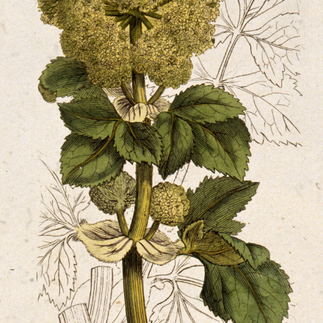


A fun aside on Cibo. Living from 1512-1600, he seems to have found quite the exquisite balance of biological accuracy and whimsical landscape painting. Honestly I can't get over these illustrations, they're insanely beautiful and detail specific. I even tried using the Seek App to see if any were meticulously painted enough to be identified. At least a quarter were correctly identified, along with another quarter being able to identify the genus but not species, and almost all identified at least as a plant. Although I've never tried this with any other illustrations so I'm not sure how much that says necessarily. Almost all of his paintings contain some sort of landscape scenery in the background. So far, my favorite of these is of the European Olive Species, which shows a group of villagers during a harvest from sometime in the 1500's. I had the same idea to do botanical illustrations with the plants in the native habitat, and am just so thrilled to find another human having done so, and as splendidly. My heart breaks with how much attention went into these paintings, and how these plants are all still around today! Perhaps I shouldn't be surprised by the later. I'll have to go through them one day and find them all in the wild, to pay homage, like a Cibo Treasure Hunt. Ooooooo, even better, to recreate the paintings in photographs. So many of the background landscapes are similar to ones found here. Yesssss. I hope I can sit and paint with him if there's time enough in an afterlife.
I have been writing this particle entry for over a month now, and I'm ready to wrap this up. So. Alexanders. What do you have to teach us? Well. From my chair in this coffee shop in Mugla, and an inability to examine artworks aside from the meager offerings of our Lord Google, I will start by saying that we need more wild plants in our diet. Especially ones that provide as much fiber and nutritive qualities and extensive preparation methods as Alexanders does. Perhaps ancient people's of this area kept vegetable gardens right outside their front doors. We should take advantage of plants that grow locally instead of relying on importing our sustenance. We should also be careful to learn about plant families as well, and do well to avoid Poison Hemlock. And lastly for now, that botanical illustration can tell a whole story instead of just the scientific bits.
smyrnium-olusatrum


Comments